

Many people still view Blockchain Technology as a new technology. However, in America it has been used in the transformation of the Finance, Health, Supply Chain, and other industries. Understanding Blockchain Technology requires you to understand Blockchain Technology first. Blockchain consists of a distributed and somewhat decentralized peer to peer network of ledgers and can be considered as a transaction record. Documents secured in the ledger, secured, transparent and immutable, which means they cannot be altered.
No cross out or watermarks. Immutable records of a fraudulent transaction means your Blockchain Enabled no fraud systems can be altered. Because modern digitized services with various components trust the systems and services. The fraud proof characteristics capture the attention of the government and enterprises.
How Blockchains Work
A blockchain involves multiple components known as blocks which contain data and transactional details. A block’s unique cryptographic key and linked, chained keys ensure a block’s transaction history is permanent. As data is stored in a distributed database, every network participant holds the same data. This functions to enhance system transparency and eliminate the need for intermediaries.
Each transaction is verified with a type of consensus mechanism, accepted as proof of stake or proof of work. The most known example of proof of work is Bitcoin as it requires miners to authenticate the transaction after solving intricate puzzles. Ethereum 2.0, on the contrary, uses proof of stake where transaction validators authenticate the transaction for the network by staking tokens, losing collateral, thus proof of stake is accepted. Blockchain is thus secured, and the system is trusted via proof of stake and proof of work.
Features of Blockchains
The permanent nature of records in a blockchain system can be considered the most noteworthy characteristic of this technology. Once data has been entered into a blockchain system, it becomes unchangeable and undismissable. This characteristic explains the reliance of Blockchain Technology and this has positively impacted its trustworthiness within the healthcare and finance sectors.
Automate specific functions within blockchains and execute contracts when predetermined conditions are satisfied.
Another important capability that blocks addition is tokenization. It creates digital and virtual representations of real-world assets and forms the foundation of Applications. Blockchain Interoperability refers to the capability of multiple blockchains to connect and communicate with one another. Such attributes improve numerous use cases in efficiency and scalability. These use cases and attributes of blockchains are particularly important for US Blockchain Technology advocates to understand.
Blockchain Technology Use in the USA

In the USA, several sectors include practical application of blockchain technology. It helps in DeFi, decreasing fraudulent practices and accelerating transactions in the financial sector.allow U.S. banks to automate loan and settlement processes, which decreases the human error in approving and settling loans.
In privacy and accuracy, immutable records blockchain technology maintains patient records in the healthcare sector. Good transparency in supply chains is the tracking of goods from producer to consumer with Blockchain Technology .In the real estate sector, tokenizing the property enables the division of the property into shares and allows for fast and efficient transactions.
The Impact of Blockchain Technology on Real-Time Financial Transactions in the USA
The benefits of Blockchain Technology on fast and almost real-time transactions in the financial sector in the USA cannot be overstated. In the USA financial sector, the automation of loan payments and settlements offered by the blockchains reduce human error and enhance transparency, thus, reducing fraud in the system. Even the use of the DeFi system is on the rise in the USA.
In a peer-to-peer set up, a collection of nodes is responsible for the validation of a batch of financial transactions. Protecting and securing private and sensitive data is done via cryptographic hash. On the blockchain, proof of work and proof of stake systems can be used for transaction validation and the mechanisms of validation and verification in the highly regulated USA credit system attest to the robust system.
Blockchain in Healthcare
Hospitals, supported by other health service providers, are concentrating on developing blockchain systems to ensure additional safeguards are put to patient record systems. To prevent unauthorized access and alteration of data, the immutable records feature of Blockchain Technology allows for the
secure system. Patients have the power to control access to their data, record privacy is thus enhanced. Critical patient care is improved and streamlined by the history of secured medical records to be shared across services hospitals. In Healthcare, the stored data confidentiality is also enhanced because not a single entity can control the access of all the sensitive data.
Utilization of blockchain technology in the real estate market.
The speed provided by Blockchain Technologies can be used in real estate transactions.that execute and validate the conditions stipulated within the agreement enables the rapid transfers of ownership and the real estate properties involved in the transactions. The integration with other records systems can be rapid and the integration of immutable records will be beneficial, while the elimination of extraneous documents and fraud which hinders real estate transactions can be mitigated. Blockchain enhances security for investors looking to buy, sell, or lease properties.
Real estate also qualifies for Tokenization, which means that small segmented investors can now participate in the market. Interoperability of Blockchain enables banks, registries, and buyers to transact. Decentralization of Blockchain Technology ensures that all involved parties can access the system equally and fairly.
Implementation of Blockchain Technology in Government Services
The US Government is commencing the use of Blockchain Technologies in order to increase transparency and efficiency in governance. Click here for the complete response. No voting, tax filing, or document verification system can offer record immutability guarantees. Government services can be offered to citizens and accessed without the risks of alteration or unreasonable delays. Each individual system of decentralized governance allows no single agency to monopolize control over sensitive information.
Bureaucracy Inc. can automate some public service processes as self-executing administrative arrangements with the government documented as” permit automation of some public service processes. Automatic data “Blocking” Services protection “Blocking” data for unauthorized access and misuse of citizens services is provided without the risk of denial. Government trust is reinforced.
Blockchain Technology in the Energy and Utilities Sector
US energy companies are starting to use Blockchain Technology to facilitate the Monitoring of the Production of Renewable Energy. Systems and resources are available to allow Consumers to Trade Excess Energy in Decentralized Markets as energy tokenization is regulated. Dispute resolution and energy distribution management efficiency are enhanced through the use of immutable transactional records and transparency.
Blocking technology interoperability to smooth energy management between producers, distributors, and consumers.Automated are capable of executing trades, managing billed energy, as well as controlling the entire billing system. They can trade energy and automate while executing all the functions.These innovations help assist reliability and transparency in the Utility Services Sector in the United States.
Benefits and Drawbacks of Blockchain Technology
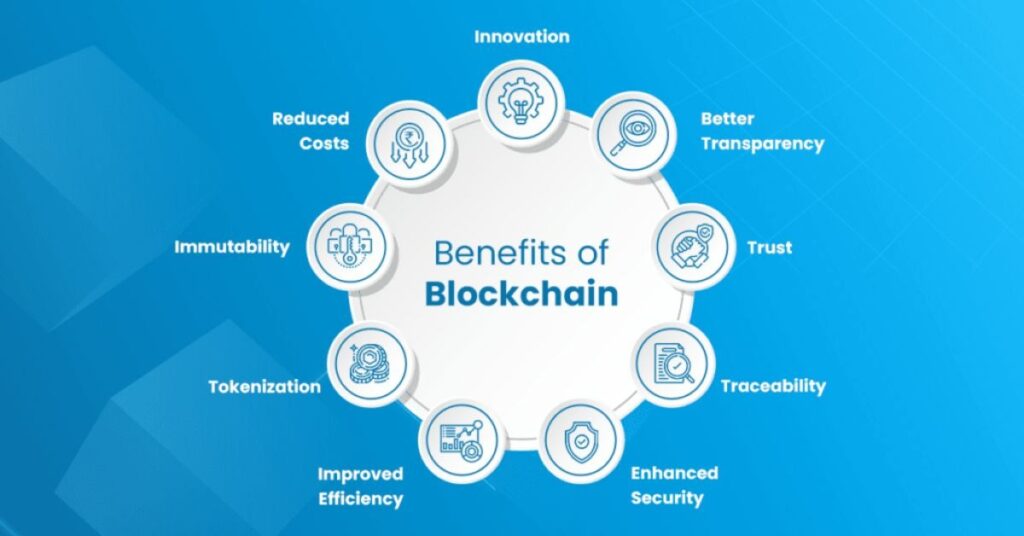
Currently, no other technology does as well as Blockchain Technology, which meets all criteria of security, transparency, and efficiency. Its peer-to-peer network capabilities eliminates the need of intermediaries, resulting in the potential for lower transaction times and costs. As no single entity has complete control over the system, the system is decentralized for lower manipulation. Blockchain Technology has the potential of automating most processes in finance and business via self-executing.
The challenges are as equally apparent as the stated benefits. For multiple reasons, Blockchain Technology lacks scalability and has potential issues with transaction processing. The proof of work systems have also received criticism for their excessive consumption of energy. The lack of informal federal regulations is one of the reasons the technology is slow to be adopted in the US. These issues are substantial, however for the majority of use cases the technology gives clear benefits that outweigh the other disadvantages.
Prospects of Blockchain Technology in the USA
Optimism is plentiful when talking about the future of Blockchain Technology in the US.There is also unprecedented growth in decentralized finance (DeFi) systems, which are designed to provide secure systems of cash management that operate independently from traditional banks.
There are possibilities to transform modern sky banking with such technology.
New systems that make Blockchain Technology more energy efficient are in the process of being created with proof of stake and interoperability blockchains design.
Tokenization technology combined with changes in regulation concerning the predictability and stability of such technology will greatly transform digital systems in real estate, digital assets, and art to the new paradigms of trust, transparency, and efficiency.
Challenges in the Acceptance of Blockchains
Technological public perception, underdeveloped technology regulation, and technology regulation gaps are also major issues. The balance debate concerning the trade-off of public and private blockchains on safety and control is largely absent.
Because of these issues, blockchain scalability and the provision of educational materials to businesses and the public should be the main focus of US investment. Predictably designed, comprehensive, consistent and rational regulations must also be provided. The everyday use of such technology will largely depend on the improvement of the security and decentralization of blockchains.
FAQs
As described in the literature, the term Blockchain Technology refers to the de-centralization of distributed ledger technology: the safekeeping and transparent authentication of peer-to-peer network transactions, and the safekeeping of transactions in distributed ledgers.
The manipulation of transactions is virtually impossible due to the cryptographic chains securing the transactions and the consensus of the decentralized nodes that validate them.
It will cover a wide variety of industries and improve efficiency and trust through opacity, decentralization, and advanced tokenization.
Conclusion
The manner in which Americans transact and manage data has been vastly reshaped owing to technology. Trust triggered by the ability to document transactions without physical restraints and the use of automates countless workflows and dispenses the need for human supervision. Blockchain Technology Trust can thus be operationalized in different sectors. The social systems and financial technologies of the USA and the rest of the world will become more integrated and technologically advanced. The USA will likely lead the world in innovation as the use of breakthrough technology in the form of blockchain will create secure systems in the vast networks of the social systems and financial technologies of the USA.
