
The future of remote work is both exciting and exhausting. We love being able to work anywhere but it’s as though people the whole wide world are welded to their screens 24/7. It’s brought comfort, flexibility and burnout in one fell swoop. Millions of people in the United States work from home or commute to hybrid arrangements, recasting our ideas about labor and offices and about what it means to balance work with life.
Others, the terms of service from home have included more time with families and less commuting stress. For others, it involves blurred lines and infinite notifications. But what we do know is that this change isn’t simply ending, and it’s being done with the future of remote work much faster than anyone could have foreseen.
Opinion A Look Back: When Working Remotely Was Roundly Mocked
But very very few members got to that. And then the pandemic arrived, and everything was different. Offices were closed, with their post-pandemic work force clicking into position at computers and cubicles where contact from a less contact-seeking past dissipated.
American companies such as Microsoft, Google and Amazon redefined what “office work” could be. An off-the-cuff solution became a surprise smash. Workers got flexible work locations and companies reaped rewards such as lower overhead and access to a global talent pool.This trend also rapidly transformed the remote working culture and turned it into what we now consider, at least, a less temporary normal.
Changing the remote work framework and the landscape of remote work positions.
And so a lot will be happening this next year… Not to get lost in the shuffle, but trends that are already shaping the path of remote work as we know it. One of the major trends is toward work that is results focused as opposed to time spent online. It’s not just about being there anymore, it’s about performance that counts: Companies now really want to know. Another factor is the growing use of remote collaboration tools like Zoom, Slack and Microsoft Teams that bind far-flung teams across time zones.
In the United States, it has been the era of freelance and gig economy. Sites built for contractors, such as Upwork and Fiverr, are allowing thousands of individuals to piece together careers outside the cubicle farm. This work at home phenomenon simply underscores the fact that freedom and technology are increasingly becoming interlinked.
| Trend | Impact on Remote Work |
| Flexible scheduling | Increases productivity and job satisfaction |
| Hybrid work model | Balances home and office collaboration |
| AI integration | Simplifies workflows and communication |
| Cloud platforms | Increase productivity and cloud-connected file access |
The Role Tech Plays In The Evolution Of Remote Work
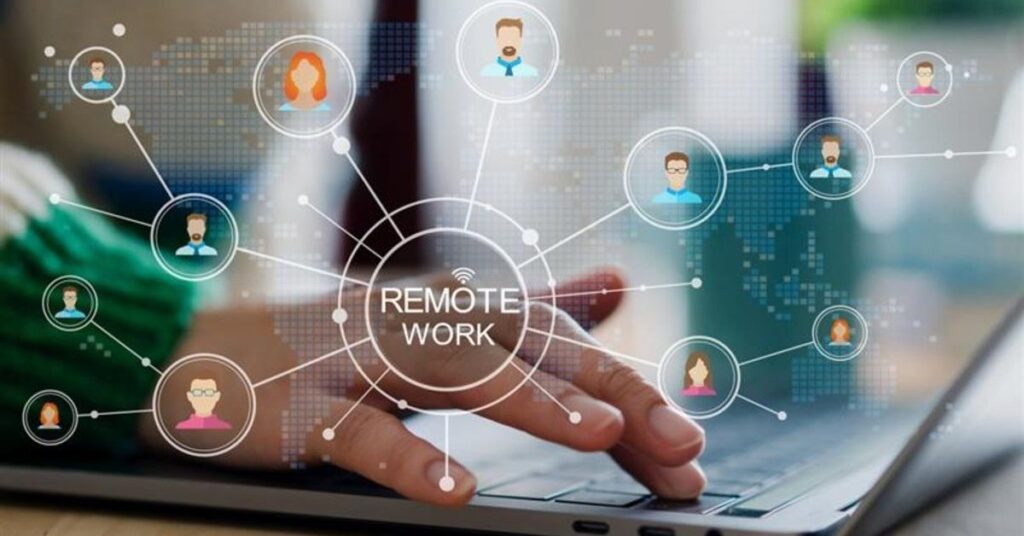
And it is technology that offers solutions to this change. The digital transformation of the office at work underway today is speeding up and enabling remote work. Project management apps like Asana, Notion and ClickUp can help you manage projects at the moment; virtual team management platforms can keep everyone on the same page.
Combine faster internet speeds with cloud-based productivity systems and 5G connections and work can happen just about anywhere from a coffee shop in Austin to a cabin in Colorado. This tech revolution also offers a solution for the disjointed workforce to stay connected and innovative, from wherever it may have its hat hung up.
AI and Automation Are Taking Over the Remote Work World Work Smarter, Not Harder.
The A.I. revolution is spreading in every corner of the world. Now AI has invaded the remote work world, from chatbots handling customer-service center calls to predictive analytics informing business decision-making. It’s a time-saver, and it relieves people from that boring stuff so they can focus on creative thinking, strategy.
But the impact of AI on remote working goes both ways.Automation, after all, doesn’t just make things easier it also risks putting some old-line employment at risk. Flexible reskilling programs are becoming a focus for companies because more and more dollars are being poured into automation and remote working environments. The key is to figure out how to be allies with AI, rather than viewing it as a competitor.
Hybrid Work Models: Rethinking Work.
And hybrid work is fast becoming America’s way of working. Employees can log in remotely but they have the option to collaborate face-to-face at the office. It’s the best of home and conference collaboration.
Businesses are reconfiguring their space for a hybrid of in-person and remote work and for new priorities: more lounges, fewer desks; take-away food and better video conferencing. The flip side of that is flexibility in the face of working requirements down the line, giving companies greater ability to shift as new demands are set — without losing staff.
How ‘Productivity’ Is Getting Reimagined by Remote Workers
First, productivity isn’t defined by a desk in remote work. And it is measured by results and outcome. These days, most organizations are monitoring projects and results with analytics applications in the mix. The effect obscures the action.But in distributed teams, productivity is about trust and communication. Distractions sneak in when you lack strong leadership and clear goals: If you establish some routines and utilize dependable software, everyone is on the same page.
Indeed, the mental pressure is often hidden in the liberty of remote work. As a result, the “always-on” society leads to blurring the line between personal time and amusement. Still, US firms already care for people’s health. “They are spending countless funds to provide services like counseling, wellness programs, and parental leave. Businesses are still more significant contributors to long-term fulfillment and productivity: fixing the virtual divisions of communication”. Hence, US firms can pay for other firms to fix it and then return more cash. In addition, American Digital nomads are already changing the world. People from the US now go to Thailand, Mexico, Portugal and do their job as they used to do in their actual full-time job. This is a powerhouse of a new model, work from wherever for all who want to get an experience. Companies invent themselves in a remote-first culture as many firms do remote retreats and online bashes, and every other mentoring culture has never been concerned so much as to be remote-read.
The: And the tools that drive it That Work For Every One of Us From Anywhere
The new class of workers prefers freedom to formality. They focus on collaborating by using technology. And apps like Zoom, Slack, Notion and Trello are key components of the remote worker’s daily routine.
AI and automation combine with these applications, as part of a world wide pool of experts. The ones who are going to do the best will be those who can pivot, communicate really well and collaborate virtually. Digital is still transforming the way we work and do business in workplaces, an ongoing evolution underpinned by digital technology, shaping modern work culture.
This generation’s buzzword is remote work and theirs is Cyber Security and Data Security.
Cyber threats are on the increase with the rush to remote work. Those house networks are low-hanging fruit, and as the rash of home break-ins demonstrate, cybersecurity for remote workers becomes a pressing need. Now, companies increasingly count on VPNs, two-factor authentication and encryption to protect sensitive corporate data.
And U.S. IT departments are leading the migration to zero trust in few resources. Employees are then taught how to safely operate on the web to avoid being phished or infected with malware. The mission: Work remotely with purpose and without providing an open invitation to hackers.
The New Economic World Rethinking How We Work From Home Is Creating
Remote work has gone global in the economy. And office occupancy levels have fallen in major cities like New York City and San Francisco, much to the chagrin of local businesses. At the same time, smaller cities and suburbs are booming as professionals flee from big cities.
Worldwide As a global SaaS company it’s very important for us to have access to the world also. This new equilibrium is an opening and a struggle. Wages are now as high in other countries as they are lower here, where companies hire for skills rather than where people happen to live in the future of remote work.
This Is What the Future of Remote Work Looks Like in 2030
It’s a gradual migration, but by 2030, more than 70 percent of the American work force will toil labor away from an attached office every month. Automation, A.I. and V.R. are likely to transform what it means to go to work. Offices are a tool for office cooperation, not every day.
No return to ‘normal’ The 2020s will pivot toward future job flexibility, lifelong learning and well-being. Leaders in pulling us up will be early responders. In a sharedfuture of remote work, there will be progress and innovation as long as people and policy evolve together.
Remote Work Revolution: Succeeding from Anywhere: The Transformative Power of Teams and Businesses Working Remotely
You can predict only for so long that something will occur before it does before you have to acknowledge that it has. The new keys to success will be flexibility, technology and humans connecting with other humans. Whatever happens, success will depend on people staying intellectually malleable and businesses staying open.
So in an office near you, soon: The unwillingness or inability to learn on your own will be the single greatest deal breaker. And, as the division between home and office becomes less defined (pun intended), you don’t just want to work remotely you want to work smarter, happier and purpose-fully.
FAQ’s
It’s working from anywhere outside a traditional office using digital tools.
Yes, on commuting, fuel, and daily meals.
Absolutely, through lower office and maintenance costs.
Use VPNs, encrypted connections. and Company Security Officer procedure.
Conclusion
The remote work of the future is both thrilling and frightening. It brings liberty to people but also inhibits their concentration and general health future of remote work. Technology, A.I. and re-engineered human jobs will decide how we work and where we decide to reside.
It is with ingenuity, not regret, that America leads. The road ahead is straightforward, flexible and at once safe, connected! Remote work isn’t only the future. This is it, we have to make do with what we have”, and it is permanently altering how we live, how we think about success.
